
Small and midcaps are leading the charge in the latest market rebound. Since November 21, when the benchmark S&P BSE Sensex and the National Stock Exchange Nifty hit their recent lows and slipped into correction territory, the Nifty Smallcap 100 index has risen by 8 per cent, while the Nifty Midcap 100 has gained 5.7 per cent. Meanwhile, the Nifty 50 index has risen by 4.7 per cent during this period.

Since October, FPIs have offloaded Indian equities worth Rs 2.1 trillion.

Buying stocks during a dip, says Amar Nandu, research analyst, Samco Securities, can lead to higher compounding returns when the uptrend begins.

'Though one cannot paint the entire microcap basket with the same brush, investors need to be careful now as to what they're buying.'

The last time these two indexes recorded a negative performance on a calendar year basis was in CY19.

Analysts are warning of growing risks to the market's sustained momentum, and even to the possibility of consolidation at current levels. Domestically, markets are grappling with several challenges, including a slowing economy, as indicated by the latest GDP data for the July-September (Q2) quarter of 2024-25 (FY25), sticky inflation, fluctuations in the rupee, waning consumption, and high interest rates.
The recent selloff in the Indian equity market has been far more painful for mid and smallcap stocks compared to largecap stocks. The benchmark BSE Sensex is now down 9.5 per cent from its record monthly closing of 84,300 at the end of September last year. In the same period, the BSE MidCap has lost 17 per cent of its value, while the BSE SmallCap has corrected by 17.1 per cent.

Retail investors have been the hardest hit in the recent market downturn, with stocks where they hold over 20% falling 45% from their 52-week highs.

Rupee depreciation, if it continues, will likely pull the markets down further. Since September 2024, the rupee has declined by 3.1 per cent, the Nifty has dropped by 8.5 per cent during the same period, and the Sensex has fallen by 7.3 per cent. If the decline continues, markets will need to brace for more pain as it could push foreign portfolio investors (FPIs) to exit their positions faster than anticipated.

According to data from BSE, the 4,357 companies available for trade had a combined mcap of around Rs 416 trillion on Tuesday against India's GDP at current prices of Rs 296.6 trillion in FY24.

'Sectors like e-commerce, small finance, housing finance, and healthcare are in great favour, and people are paying a PEG ratio of up to 5, which is dangerous.' 'Wealth destruction is inevitable.'

'Invest only in stocks of those companies that deliver on earnings and there is earnings visibility too for the next few quarters.'

'Over the next 12 months, it will be difficult to make 15 to 20 per cent return in the markets as the valuations appear stretched.'
The universe of stocks trading at a 12-month forward price-to-earnings (P/E) multiple of 50x or more has swelled by 2.5x to 104, indicating the growing froth in the market. In March 2023, the number of stocks with a P/E of 50x and 100x stood at 41 and 3, respectively, which has now grown to 104 and 9, according to an analysis by Kotak Institutional Equities (KIE).

As regards mid-caps and small-caps, analysts suggest investors buy only those stocks of those companies where there is earnings visibility for at least a few quarters and where the valuations have become reasonable.

'Expectations are high regarding the change in LTCG with respect to equity investments.'

Analysts are of the view that long-term investors could continue to hold the stock, irrespective of the MSCI development.

Domestic institutional investors pumped Rs 2.3 trillion into equities during H1 CY24. Of this, mutual funds contributed 80%.

Automobile, apparel and electronics are among sectors that see a sales boost during the festival season, a time when investors expect gains in related stocks. This year could be different: Analysts have factored in all positives and do not expect such stocks to deliver lucrative returns. "Indian households spend across sectors like automobiles, consumer durables, and consumer staples during the festival season.

'We expect market consolidation and recommend buying during market dips.'

''The outcome of the state polls may lead to some strategy-related permutations and combinations and the markets may extrapolate it to the likely outcome in the general elections.'

Had you invested Rs 10,000 each in JSW Steel, Titan Company and Bajaj Finance 20 years ago, when they were just penny stocks (trading below Rs 10), you would have become a millionaire by now.

Water projects firm Vishnu Prakash R Punglia, the 20th company to launch its IPO in the current year, saw its shares closing at a 47 per cent gain over its issue price on Tuesday. Such a huge one-day pop is considered rare; however, it has become the norm this year. The average listing-day gain for these 20 IPOs in 2023 is 34 per cent, and their average gain to date stands at 46 per cent.

Since UK referendum outcome to exit European Union last Friday, 32 companies have hit record highs.

'It is advisable to stay away from the markets for now and buy only on a dip.'

The S&P BSE Midcap and the S&P BSE Smallcap indices have managed to stay afloat in a volatile January that saw the frontline indices hit their respective 52-week high levels and then slip. While the S&P BSE Sensex has lost over 2 per cent thus far in January, the S&P BSE Midcap and the S&P BSE Smallcap indices have gained nearly 2.5 per cent and 4 per cent, respectively during this period.

Analysts remain bullish on the road ahead for the equity markets, but warn against volatility on account of domestic and global cues. The upcoming Lok Sabha elections back home and the interest rate trajectory of the US Federal Reserve, they said, will be the two most important factors that the markets will keep a tab on. That apart, the valuation of the Indian markets, they feel, will also be eyed in context of how global peers are performing.

A lot of mid and small-caps are in the bubble zone and command high valuation and have corrected sharply.

'We suggest an equity strategy of 5% to 10% exposure to cash, 5% to Gold ETF, close to 50% to Sensex/Nifty/large mid-cap stocks.'
Stocks of small- and mid-cap companies continued to gain ground in July, notwithstanding analysts sounding caution on these two market segments given the sharp run thus far in calendar year 2023 (CY23). Sanjeev Prasad, co-head of Kotak Institutional Equities, in a note co-authored with Anindya Bhowmik and Sunita Baldawa in June-end, had cautioned against the sharp run in small- and mid-caps. "We do not see any particular reason for the excitement in small- and mid-cap stocks.

With the markets scaling new highs, as many as 43 stocks from the Nifty50 index and 27 of the 30 scrips that are part of the S&P BSE Sensex are trading above their respective 200-day moving average (DMA). The 200-DMA is seen as one of the most relevant trend indicators by investors and traders, who believe that stocks and indices trading above this level possess strength and are likely to rally in the short to medium term, while the ones trading below this level are viewed as bearish and expected to see a sell-off. Wipro, UPL, Kotak Mahindra Bank, Hindalco, Infosys, Cipla, and Adani Enterprises are the only stocks from the Nifty50 pack that are still below their respective 200-DMA, the exchange data suggests.

The Indian aviation sector is on the cusp of a change as airlines look to induct a record number of aircraft. This, analysts said, will put the sector on a growth runway, though keeping it viable for only long-term investors. According to Vinit Bolinjkar, head of research at Ventura Securities, expectations of strong air traffic, coupled with low penetration, is the prime reason for a solid long-term outlook.

The joint venture of Jio Financial Services and BlackRock to foray into India's asset management space could be disruptive but not disastrous for incumbent industry players, analysts said on Thursday. As an investment strategy, analysts suggest investors stay put in shares of those AMCs that consistently improve business metrics, and where market capitalisation-to-asset under management (AUM) valuation is not stretched. However, growth expectations of incumbent players may get trimmed in the medium-to-long term, analysts said, once the Jio-BlackRock JV unveils its plans, discounting the looming challenge as significant enough to dent their profitability.

At an aggregate level, the late ace investor's portfolio that was valued at Rs 32,445 crore as on March 31, 2023 is now worth Rs 35,979 crore.

Public-sector enterprise stocks have seen a good run thus far in 2023-24 (FY24), with the S&P BSE PSU Index surging by over 26 per cent during the period, compared to an 11 per cent increase in the benchmark S&P BSE Sensex.

The Indian markets have seen a good run in the last three months with the S&P BSE Sensex rising around 7 per cent and the Nifty50 moving up 7.5 per cent. The next leg of the market rally from here on, analysts suggest, will be driven by a growth in corporate earnings over the next few quarters. That said, they do not expect material / sharp downgrades to India Inc's earnings estimates despite headwinds for the economy.

It has mostly been a one-way street for smallcap stocks that have taken it on their chin thus far in February. The Nifty Smallcap 250 index has shed 3.2 per cent in the current month as compared to the 1.8 per cent decline in the Nifty Midcap 100 and the 0.5 per cent drop in the Nifty 50 index, data showed. Technically, the index has slipped below its 20-day moving average (DMA) placed at 14,800 levels on Monday, and is currently testing the 50-DMA, and is placed at 14,278 levels.

After a sharp fall in the share prices of HDFC Bank and other private sector lenders in the past three days, the BFSI (banking, financial services and insurance) sector weighting in the Nifty50 has slipped to a seven-year low of 32.03 per cent, down from nearly 36.6 per cent at the end of March 2023 and 34.5 per cent at the end of December 2023.
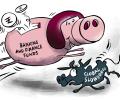
Even as banks and finance companies are reporting record-high earnings, their weighting in the benchmark National Stock Exchange Nifty50 Index has seen a downward trajectory. Investors expect a stronger performance from other sectors in the new year. Currently, banking, financial services and insurance (BFSI) companies collectively hold a weighting of 34.5 per cent, down from 36.7 per cent at the end of December 2022 and a record high of 40.6 per cent at the end of December 2019. This represents the sector's lowest weighting in the index since December 2021 when it stood at 33.7 per cent.

'Focus on 19,400/64,900 as the key resistance levels for the Nifty/Sensex.'
